
“Jissen Global Festival” Held at Shibuya Campus: Connecting People Across Generations and Nationalities Through Global Exchange (Apr. 25)
Apr 25,2026
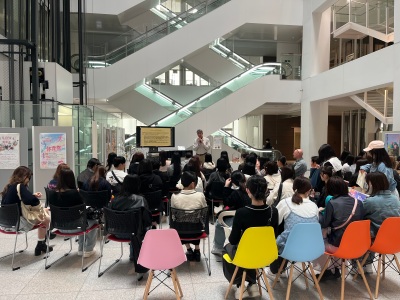
April 25 at the Shibuya Campus. A variety of programs allowed participants to experience global cultures in a familiar and engaging way.
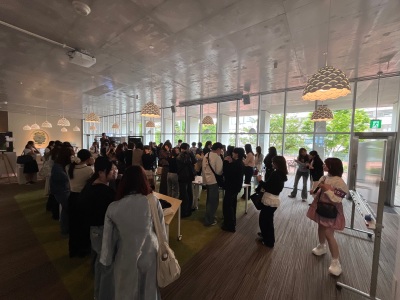
A total of 224 people attended the event, exceeding last year’s attendance of 163 participants. In addition to Jissen students and international students, participants included students from other universities, representatives from partner companies and organizations, parents of Jissen students, and students from the affiliated junior and senior high schools. This was the second time the festival had been held as part of the university’s efforts to promote one of its two key educational pillars: globalization.
As a new initiative this year, Professor Bulach from Center for Language Education and International Programs gave a mini lecture introducing overseas culture through the theme of Easter in Germany, which attracted significant interest. The event also welcomed children participating in interview activities with international tourists in Asakusa, Tokyo, creating opportunities for interaction that transcended both generations and nationalities.
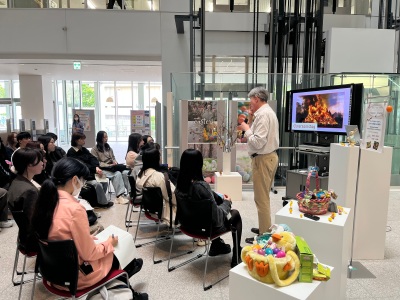
Mini Lecture on the German Easter by Professor Black from Germany
Professor Bulach, who is from Germany, explained in English using Japanese-language slides, saying, “Easter is a very global event. It is celebrated not only in Germany, but also in the United States, Australia, China, and Japan.” He emphasized how widely recognized the celebration is around the world while also noting that Easter is not as familiar in Japan as Christmas, highlighting cultural differences between countries.
The lecture focused on the meaning of Easter. Easter celebrates the resurrection of Jesus Christ three days after his crucifixion. In religious terms, Easter is considered even more important than Christmas. It is also a celebration of the arrival of spring.
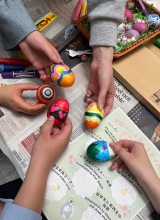
One topic that particularly captured participants’ attention was the tradition of Easter eggs. Using real eggs during the lecture, Professor Black explained, “In Germany, people paint and decorate real eggshells.” He also introduced the historical background, saying, “In the past, people were not allowed to eat eggs during the 40 days before Easter, so the eggs preserved during that period were later eaten or decorated at Easter.”
He also spoke about Easter baskets, another essential Easter tradition. “Families prepare Easter baskets for children,” he explained. “They are filled with sweets, chocolates, and small presents.” He added that it is traditional to hide the baskets in gardens or around the house for children to find.
Professor Bulach concluded by saying, “Easter is a celebration that contains both sadness and joy. There is sadness over the death of Christ, but also joy in his resurrection. That is why Easter is such an important day.”
The lecture took place in a warm and friendly atmosphere, allowing participants to experience German culture and values while listening to explanations in English. Through Professor Bulach’s personal experiences and humorous storytelling, Easter became a much more familiar and relatable tradition for attendees.
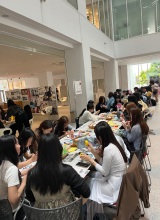
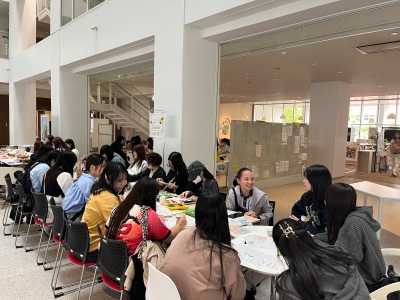
Following the lecture, participants had the opportunity to paint their own Easter eggs. Participants commented, “It was very interesting to learn about something we do not often experience in Japan,” and “Making Easter eggs helped me understand and enjoy the tradition even more.”
Study Abroad Experience Expanded My Perspective on Different Cultures!
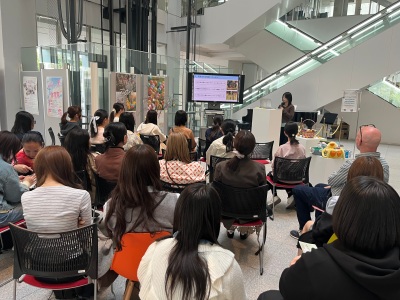
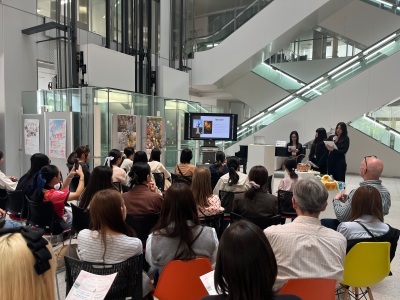
The next session featured presentations about study abroad experiences. Ms. Honoka Ishigaki, a fourth-year student in the Department of Contemporary Social Studies (currently the Department of Business Society), introduced her approximately four-month study abroad experience at Dankook University in South Korea beginning in February 2025.
Reflecting on what she learned through studying abroad, Honoka said, “I realized the importance of choosing my own environment and creating my own path. I feel that my sense of independence changed greatly.” She explained that while interacting with students from many different countries broadened her perspective, she also faced many situations that required her to think and act independently. She described how those daily experiences contributed to her personal growth.
“Entering a new environment can be intimidating, but the rewards of taking on the challenge are enormous,” she said, encouraging participants by adding, “If you are unsure about studying abroad, I hope you will give it a try.”
In addition, international students from Cambodia and Georgia introduced their home countries and cultures. Participants showed great interest in learning about cultures and lifestyles they do not usually encounter.
A message relay game using the native languages of international students also brought excitement to the venue, as participants enjoyed communicating across language and cultural differences.
The event also welcomed children participating in “Ninja Challenge KIDS,” a program in which children dressed as ninjas interview international tourists mainly in Asakusa. The children interacted with Professor Bulach in English about Japanese food culture, demonstrating their ability to share familiar aspects of Japanese culture in English.
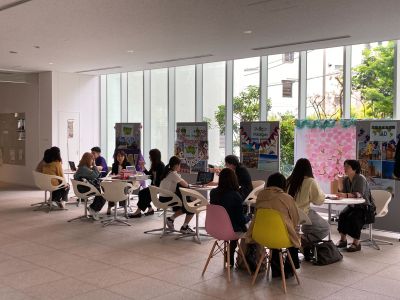
Other activities included origami workshops and a “My Vision Board” corner, where participants could freely express their future dreams and goals. Student staff members played central roles in planning and operating each activity area, bringing their own creative ideas to life.
By combining lectures with hands-on experiences, the program provided participants with opportunities not only to understand linguistic and cultural differences but also to experience both the challenges and enjoyment of communicating in their own words.
According to the post-event survey, more than 90% of participants reported being satisfied with the event. In addition, 96% responded that they felt the world had become more familiar to them, with many comments such as, “I want to learn more about different cultures,” and “My perspective has broadened.”
Student Voice
— Reflections from a student who served as the MC for the International Student Exchange Corner —
"Although I was nervous at first, the experience allowed me to put into practice the skills needed to foster meaningful interaction among participants."
As the MC for the Telephone Game, I was responsible for guiding an activity that included many international students. It was challenging to communicate in a way that everyone could easily understand, but I soon realized that gestures and facial expressions often helped bridge language barriers. Watching participants engage with one another and seeing a sense of unity develop throughout the event was incredibly rewarding. This experience taught me the importance of creating opportunities for people from different backgrounds to connect and communicate.